
HTTP/3 (QUIC) Support
This guide is maintained for Ruk-Com PaaS. Screens and options may vary by platform version and account permissions.
Confirm the environment, region and account permissions, and back up current settings before changing a production system.
Objective
This guide explains how to use HTTP/3 (QUIC) Support on Ruk-Com Cloud PaaS, with ordered procedures and practical verification points.
Before you begin
- Sign in with an account permitted to manage the relevant environment.
- Confirm the target environment, region and resources before saving changes.
- Create a backup or rollback plan before changing a production system.
HTTP/3HTTP/3 (formerly known as "HTTP over QUIC") is the third version of the Hypertext Transfer Protocol family. It is very similar to HTTP/2 but has some important advantages due to fundamental changes in the way it is used. HTTP/3 is built onQUICtransport protocol, which runs on UDP instead of TCP
HTTP/3 is currently available in some solutions (such as LiteSpeed and NGINX) and is adopted by the following latest stack platforms:
- load balancers: LiteSpeed Web ADC,Varnish,NGINX
- application servers: LiteSpeed WS,LLSMP & LEMP,NGINX PHP,NGINX Ruby
Below you can check:
- Basic technical conditions for HTTP/3 use
- Benefits of HTTP/3 (QUIC)
- Integration with Ruk-Com Cloud PaaS
Basic technical conditions for HTTP/3 use
The main reason for adopting HTTP/3 is that HTTP/2 reaches its limit in speed improvement due to the bottleneck of the TCP protocol. Although reliable, all round-trip required to handshakes the sending response. TCP's ordering and verification guarantees are considered weak and redundant. As part of the TCP/IP stack, TCP is implemented in the kernels of operating systems. and device firmware Making major changes to TCP is nearly impossible.
Tips:Below we provide an example of some of the limitations of TCP:
- A single TCP connection can transfer data over multiple streams; However, packet loss preserves the entire connection. (and the entire stream) until TCP sends a new packet.
- TCP does not have TLS built in, so secure connections require additional round-trips, causing delays.
UDP has no such limitations and is as ubiquitous as TCP, which allows it to be improved without major changes to existing operating systems and device firmware. Therefore, the HTTP/3 implementation of the QUIC transport protocol (initially developed by Google) based on UDP is very useful. With famous companies like Google and Facebook already using it, the efficiency and reliability of the QUIC solution are undeniable.
Main features of HTTP/3 (QUIC)
Using QUIC as a base instead of TCP allows for many of the benefits of HTTP/3. Using QUIC on top of UDP provides TCP-like features without the blocking points. So let's summarize the key features of HTTP/3 compared to its predecessor HTTP/2:
- Multiplexing improvements: Packet loss affects only one stream. (not all within the same connection)
- Faster connection setup: A protocol that self-manages security features, reducing the number of round-trips for connection establishment. (This is especially evident on networks where connections have long delays, such as for mobile users.)
- Connection migration: Using the connection ID instead of the destination IP helps ensure packet delivery in the event of a network switch (e.g. downloads via HTTP/3 will be performed when the wifi connection switches to a mobile network).

In general, HTTP/3 aims for fast and reliable connections, which is especially noticeable when connections have long delays. So from a performance perspective Mobile users will benefit the most, but these are improvements that everyone will be happy with.
Integration with Ruk-Com Cloud PaaS
Support for the HTTP/3 (QUIC) protocol is still in the early stages of implementation. However, some solutions are already available (e.g.LiteSpeed) and is currently being developed by others.
- load balancers
- LiteSpeed Web ADC: All versions
- Varnish:Version5.2.x,6.x.xup
- NGINX:Since its launch1.16.1
- application servers
- LiteSpeed WS:All versions
- LLSMP:All versions
- LEMP:Since the release of 1.16.1
- NGINX PHP:Since release 1.16.1 for PHP versions 7.2.26, 7.3.13, 7.4.1 and higher.
- NGINX Ruby: Since the release of 1.16.1 for Ruby versions 2.4.9, 2.5.7, 2.6.5, 2.7.0 and higher.
Simply create an environment topology that contains the application server or load balancer mentioned above.
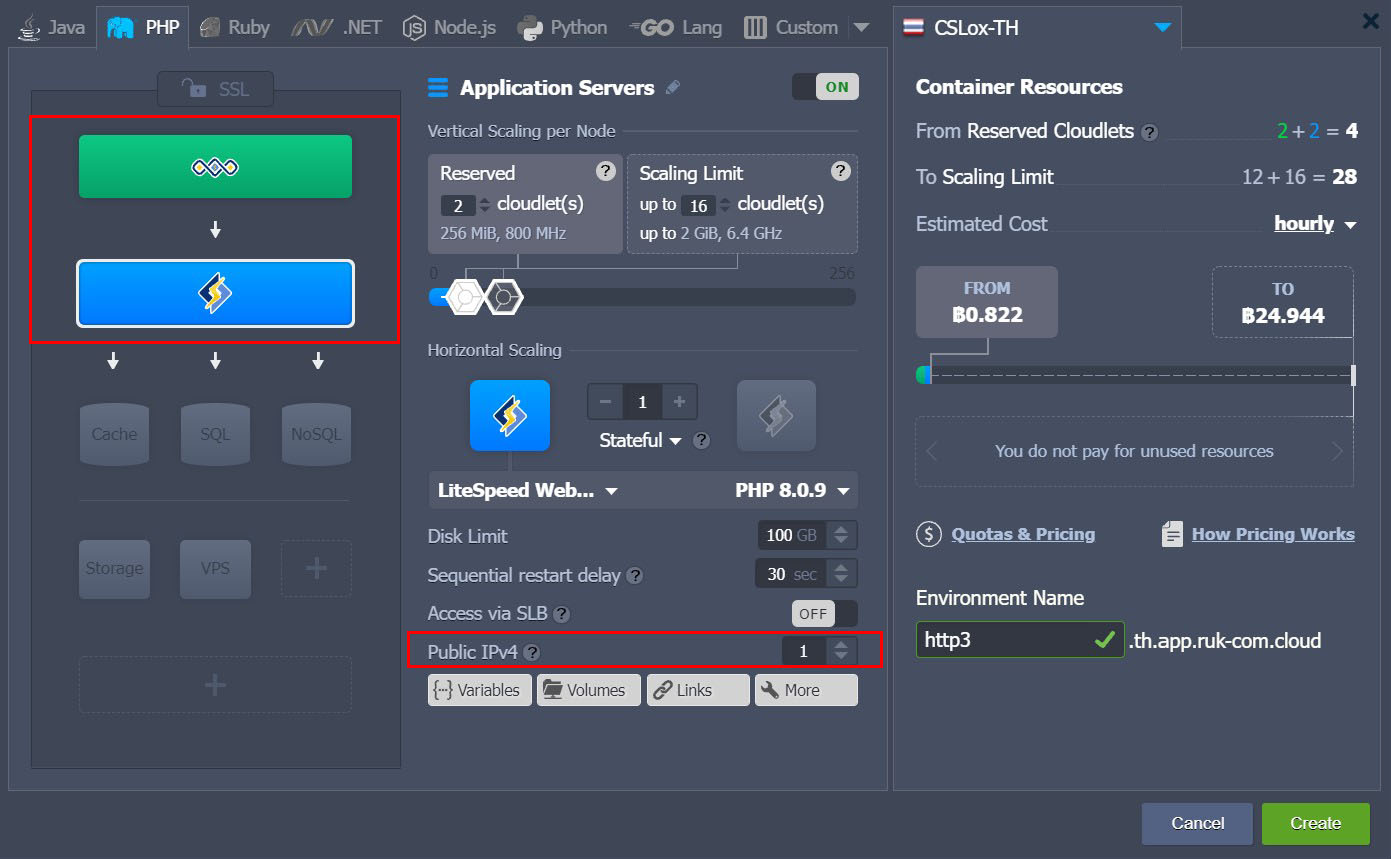
In this step you will need to attach an additional public IP to bypass the Shared Load Balancer and allow it to work directly with the server over HTTP/3.
Note:On the client side, HTTP/3 (QUIC) support is currently enabled by default in Chromium and can be configured in Chrome, but is not yet available in the Firefox browser.